
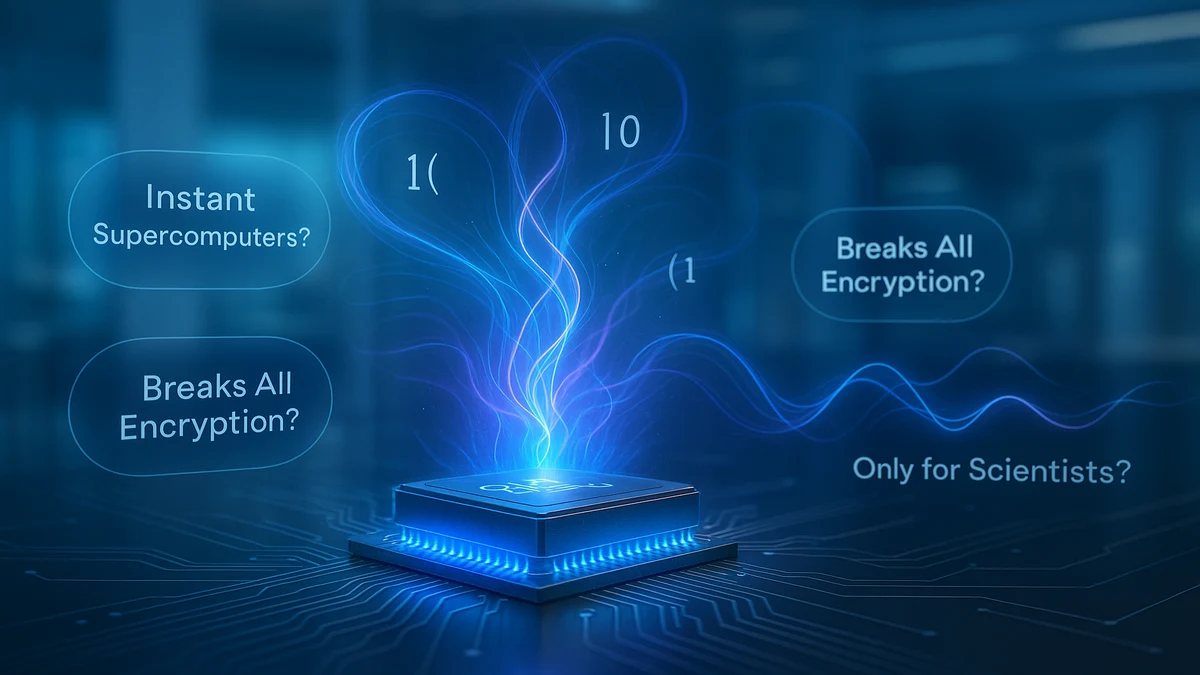
Quantum computing has captured the imagination of scientists, business leaders, and technology enthusiasts worldwide. However, along with genuine excitement comes a flood of misconceptions and exaggerated claims. In 2025, as quantum technology edges closer to practical applications, it’s time to separate fact from fiction. Let’s debunk five of the most persistent myths surrounding quantum computing and understand what this revolutionary technology can actually do.
Myth 1: Quantum Computers Will Replace Your Laptop
One of the biggest misconceptions about quantum computing is that these machines will eventually replace conventional computers for everyday tasks like browsing the internet, writing documents, or streaming videos. This couldn’t be further from the truth.
Quantum computers are not better versions of classical computers. They’re fundamentally different machines designed for completely different purposes. A quantum computer would actually perform terribly at tasks your smartphone handles effortlessly. Loading a website, playing a video game, or running word processing software would be incredibly inefficient on a quantum machine.
Think of it like comparing a submarine to a sports car. Both are impressive vehicles, but you wouldn’t drive a submarine to work or take a sports car underwater. Quantum computers excel at specific complex calculations involving optimization, simulation, and cryptography, while classical computers remain superior for general computing tasks.
The future will see quantum and classical computers working together, each handling the tasks they’re best suited for. Your laptop isn’t going anywhere. Instead, you might someday access quantum computing power through the cloud when you need to solve specific problems that benefit from quantum processing.
Myth 2: Quantum Computers Can Break All Encryption Right Now
Perhaps no myth causes more panic than the belief that quantum computers can currently crack all encryption and make our data completely vulnerable. While quantum computers do pose a theoretical threat to certain types of encryption, the reality in 2025 is far less dramatic.
Current quantum computers, despite impressive advances, don’t yet have enough stable qubits or sufficient error correction to break modern encryption standards. The quantum computers that exist today are still in relatively early stages of development. Breaking the encryption that protects your bank account or email would require quantum computers far more powerful than anything available now.
Organizations are looking to implement post-quantum encryption techniques in 2025, preparing for a future when quantum computers might pose a real threat. However, while quantum computing algorithms could theoretically break current encryption standards, they remain theoretical rather than a reality. The timeline for when quantum computers might actually threaten widely used encryption is still measured in years, not months.
This doesn’t mean we should be complacent. Cybersecurity experts are already developing quantum-resistant encryption algorithms, and forward-thinking organizations are beginning to implement these protections. The key word here is preparation, not panic.
Myth 3: Quantum Computing Is Just Really Fast Classical Computing
Many people imagine quantum computers as simply super-fast versions of regular computers, processing the same calculations but at incredible speeds. This misconception misses the entire point of what makes quantum computing special.
Quantum computers don’t just work faster. They work differently. Classical computers process information as bits that are either zero or one. Quantum computers use quantum bits, or qubits, which can exist in multiple states simultaneously through a phenomenon called superposition. This allows them to explore many possible solutions at once rather than checking each one sequentially.
Additionally, quantum computers leverage entanglement, where qubits become interconnected in ways that have no equivalent in classical computing. These quantum properties enable entirely new approaches to problem-solving that aren’t just faster versions of classical methods but fundamentally different strategies.
For certain specific problems like simulating molecular behavior, optimizing complex logistics, or factoring large numbers, quantum approaches can potentially solve problems that would take classical computers thousands of years. However, for many everyday computing tasks, quantum computers offer no advantage whatsoever, no matter how fast they become.
Myth 4: Quantum Computers Work at Room Temperature
Science fiction movies and popular media often show quantum computers as sleek machines sitting in ordinary offices. The reality is far more demanding. Most quantum computers require incredibly cold operating temperatures, close to absolute zero, which is colder than outer space.
These extreme cooling requirements aren’t just a current limitation that engineers will soon overcome. They’re fundamental to how most quantum computers work. At normal temperatures, quantum states collapse almost instantly due to thermal noise. Maintaining the delicate quantum states necessary for computation requires sophisticated refrigeration systems that cost millions of dollars and consume substantial energy.
Some researchers are exploring quantum computing approaches that might work at higher temperatures, and there have been interesting developments with different types of qubits. However, in 2025, the vast majority of functional quantum computers still require these extreme conditions. This means quantum computers will likely remain in specialized facilities rather than sitting on desks in regular offices.
The cooling requirements also contribute to why quantum computers won’t replace classical computers for everyday tasks. The infrastructure needed to maintain quantum states makes these machines impractical for general-purpose computing, even as the technology matures.
Myth 5: Quantum Computing Will Solve Every Problem Instantly
Perhaps the most damaging myth is the belief that quantum computers are magical problem-solving machines that can tackle any challenge instantaneously. This misconception leads to unrealistic expectations and misguided investments in quantum technology.
Quantum computers provide advantages only for specific types of problems. These include optimization challenges with many variables, simulating quantum systems like molecules or materials, certain machine learning tasks, and breaking specific types of encryption. For many other problems, including lots of important real-world challenges, quantum computers offer no benefit at all.
Even for problems where quantum computing helps, the advantage varies dramatically. Some problems might see modest speedups, while others could see revolutionary improvements. Understanding which category your problem falls into requires deep expertise in both the problem domain and quantum computing capabilities.
Furthermore, quantum computers don’t automatically provide perfect answers. They’re probabilistic machines that provide likely solutions, which often need verification using classical computers. The process of formulating problems in ways quantum computers can address, running the quantum algorithms, and interpreting results remains complex and time-consuming.
The Real Promise of Quantum Computing
Despite debunking these myths, quantum computing remains genuinely exciting technology with tremendous potential. In 2025, we’re seeing real progress toward practical applications in drug discovery, materials science, financial modeling, and cryptography. Companies like Diraq have demonstrated that silicon-based quantum chips can maintain world-class accuracy even when mass-produced in semiconductor foundries, achieving over 99 percent fidelity in two-qubit operations.
The key to benefiting from quantum computing is having realistic expectations. This technology will transform specific industries and enable breakthroughs in certain scientific fields. However, it’s not magic, and it won’t replace the computers we use every day. Understanding what quantum computing can and cannot do allows businesses and researchers to invest wisely in this promising technology while avoiding costly mistakes based on misconceptions.
As quantum computing continues evolving, staying informed with accurate information rather than hype will be crucial for anyone hoping to leverage this revolutionary technology effectively.